
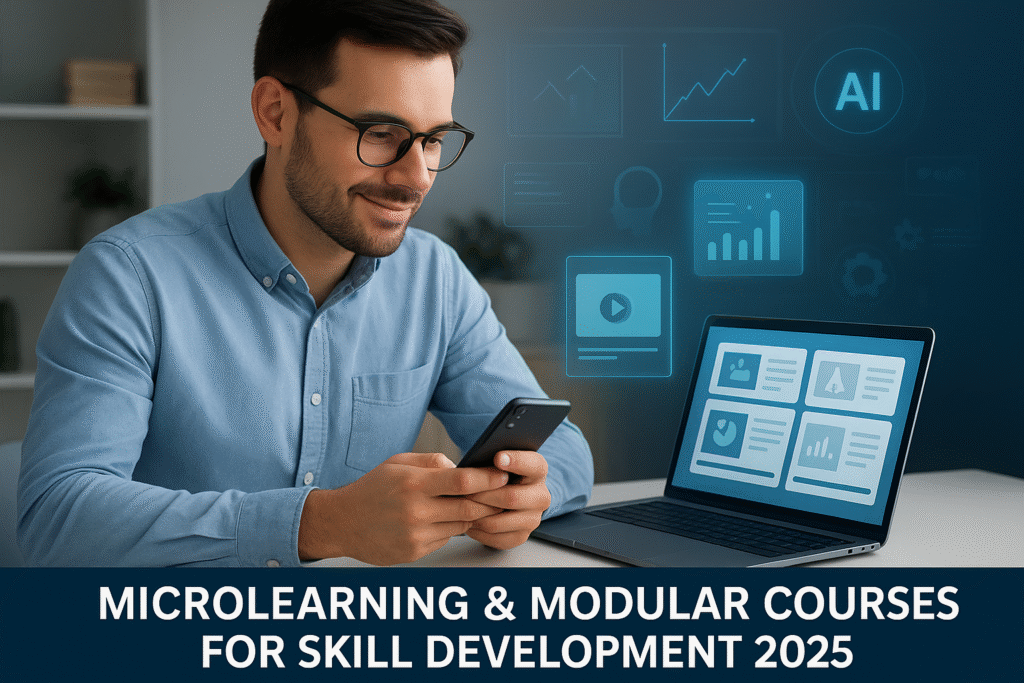
Need to upskill—fast? Microlearning is your shortcut. Instead of long courses, it delivers focused, bite-sized lessons you can apply immediately. As a result, you learn faster, practice more often, and remember better. Most importantly, it turns “I’ll learn someday” into measurable daily progress.
What Is Microlearning and Why Does It Work?
Microlearning delivers content in short, focused segments—usually three to ten minutes—designed around one specific outcome. You skip the three-hour lecture. Instead, you complete quick modules during a commute, coffee break, or between meetings.
Why it works:
- Spacing effect: Repeated short sessions move knowledge into long-term memory.
- Focused attention: Small chunks reduce overload and help you apply learning right away.
- Immediate action: Quick micro-tasks give practice and boost confidence.
Because of this, microlearning aligns with how your brain works and how your schedule flows.
Why Microlearning Is Perfect for 2025
In 2025, skills have shorter shelf lives. AI tools evolve monthly, industries shift rapidly, and roles change overnight. Therefore, microlearning helps you keep pace without putting your life on pause.
Key advantages:
- Always updated: Short lessons are easy to refresh as technology changes.
- Mobile-first: Learn anywhere, anytime, on any device.
- Personalized: Pick lessons that match your goals.
- Low friction: Fewer barriers lead to higher completion rates and consistent habits.
Skill Areas Supercharged by Microlearning
1. AI and Automation
Instead of heavy manuals, learn prompt patterns for generative AI or simple automations. For example, try a seven-minute lesson on writing an effective brainstorming prompt, then use it in real projects.
2. Data Literacy
Skip a semester-long course. Daily micro-lessons such as “read a chart,” “spot a misleading axis,” or “create a pivot table” make you data-confident within weeks.
3. Communication and Leadership
Focus on one skill at a time—giving feedback, running stand-ups, or handling conflict. Even a two-minute checklist before a tough meeting can change results.
4. Product and Design
Learn short lessons on user stories, acceptance criteria, wireframing rules, or A/B testing. Teams build a shared vocabulary without leaving their sprint.
5. Career Transitions
Switching roles? Microlearning helps close gaps fast. Examples include:
- “SQL basics in 10 days”
- “UX research questions”
- “Sales discovery—three scenarios”
Small wins stack into lasting growth.
The Microlearning Playbook
Step 1: Set a Clear Goal
Choose one outcome for 30 days. For instance:
- Automate a spreadsheet with AI.
- Deliver a crisp five-minute weekly update.
- Create a dashboard with three KPIs.
Step 2: Break It Into Micro-Skills
Divide the goal into five to eight units, each learnable in under 10 minutes.
Step 3: Use the 3-3-3 Routine
- Three minutes: Learn a concept.
- Three minutes: Apply it to a task.
- Three minutes: Reflect on results.
Step 4: Use Just-in-Time Resources
For structured micro-courses, roadmaps, and playbooks, explore SkillDevelopment.info. For AI workflows and templates, check AI Mastery Plan.
Step 5: Track Micro-Wins
Use a simple streak tracker or checkmarks. Small wins build a feedback loop that keeps you motivated.
Real-Life Scenarios
Case Study 1: The Busy Manager
An operations manager wanted sharper team updates. She used a 10-day microlearning sprint. Result: her updates dropped from nine minutes to under four, with clearer priorities and fewer follow-ups.
Case Study 2: The Analyst
A marketing analyst took five-minute lessons on chart design and headlines. Result: stakeholders finally understood insights, and meetings became shorter.
Case Study 3: The Developer
A backend developer practiced prompt engineering 12 minutes daily. Result: faster code reviews and reusable prompts for the whole team.
Designing Effective Micro-Lessons
- Keep it single-outcome: Answer one question or teach one technique.
- Start with a hook: Explain why it matters, then give a quick win.
- Use constraints: For example, “write an email in 75 words.”
- Stack practice, not trivia: Create micro-projects like a 60-second pitch.
- Encourage feedback: Use simple rubrics such as “Clear, Concise, Concrete.”
Tools and Formats That Work in 2025
- Short videos with transcripts.
- Interactive cards with checklists.
- Chat-based practice.
- Two-minute podcasts.
- GIFs or screen snippets for tutorials.
A Weekly Microlearning Schedule You Can Try
- Monday: Learn a concept and apply once.
- Tuesday: Apply it twice in different contexts.
- Wednesday: Review mistakes and refine.
- Thursday: Do a mini-challenge.
- Friday: Share a micro-deliverable for feedback.
- Weekend: Recap with a short podcast or note.
Metrics That Prove It’s Working
- Output frequency: How many small artifacts did you produce?
- Cycle time: How long to ship a usable draft?
- Error rate: Are mistakes decreasing?
- Transfer: Did you use the skill in a new situation?
- Confidence: Rate yourself before and after each week.
Common Mistakes to Avoid
- Consuming without creating.
- Focusing on too many topics.
- Oversized lessons (more than 10 minutes).
- No feedback loop.
- Skipping reflection.
Building a Microlearning Ecosystem
- Create a shared library of five-minute resources.
- Standardize lesson formats.
- Pair mentors with learners.
- Run two-week learning sprints.
- Measure outcomes like response time or quality.
Getting Started Today: A 30-Day Challenge
- Week 1: Define your goal and outline five to eight micro-skills.
- Week 2: Practice daily using the 3-3-3 method.
- Week 3: Add peer feedback and improve.
- Week 4: Ship a mini-capstone like a short talk or working prototype.
Conclusion: Small Lessons, Big Leaps
Microlearning transforms ambition into daily action. With short, focused lessons, you build momentum, reduce overwhelm, and apply skills immediately. In today’s fast-changing world, the ability to learn in minutes—and use it right away—is your competitive edge.
Commit to nine minutes a day, and within a month you’ll not only know more—you’ll be doing more, with confidence.
Frequently Asked Questions (FAQs)
1. What is the importance of developing new skills?
Developing new skills helps you grow personally and professionally, improves confidence, and opens doors to better opportunities.
2. How do career skills differ from technical skills?
Career skills are soft skills like communication, leadership, and teamwork, while technical skills are practical abilities such as coding, data analysis, or digital tools.
3. Can learning technical skills improve job opportunities?
Yes, mastering technical skills makes you more employable in today’s digital-driven job market.
4. Which skill should I learn first—career or technical?
It depends on your goals. If you’re preparing for jobs, start with career skills. If you want expertise in a field, focus on technical skills.
5. How long does it take to build new skills?
The time varies depending on the skill. Some can be learned in weeks, while others may take months or even years to master.
6. Are online platforms useful for skill development?
Absolutely! Online platforms provide flexible, affordable, and high-quality learning resources that help you grow at your own pace.
7. What are the benefits of career skills in the workplace?
Career skills help you communicate better, work effectively in teams, and handle challenges confidently—making you more valuable to employers.
8. Can skill development lead to career growth?
Yes, improving your skills boosts your performance, increases your chances of promotion, and strengthens your long-term career growth.
9. Do I need both technical and career skills to succeed?
Yes. Technical skills help you perform tasks, while career skills ensure you can work with people, manage responsibilities, and achieve success.
10. How do I stay motivated while learning new skills?
Set clear goals, track progress, practice regularly, and celebrate small achievements to stay motivated on your learning journey.